

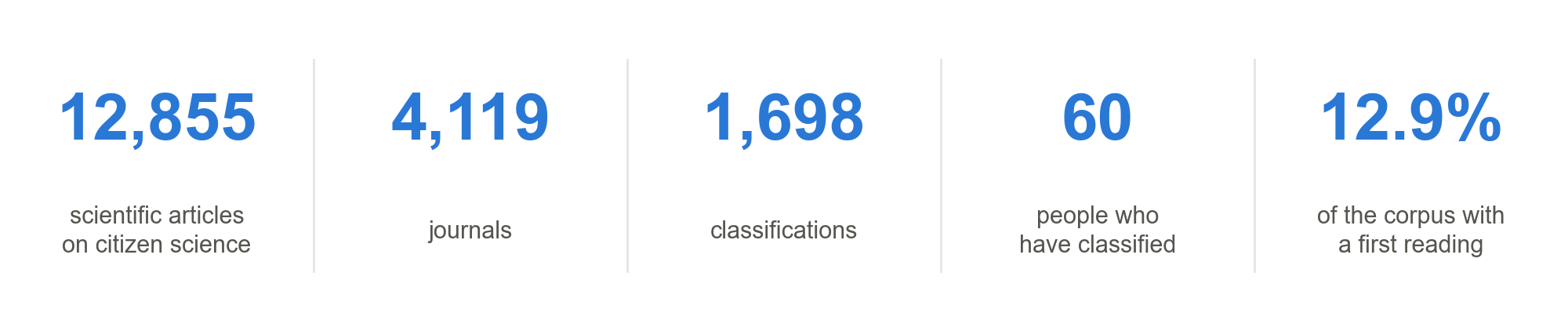
The CitSciSort platform, developed by the Ibercivis Foundation as part of the European project RIECS-Concept, aims to analyse 12,855 scientific articles on citizen science. Sixty people have already read and classified the first 1,654.
A first reading, still provisional, shows that citizen science is above all a working tool in zoology, entomology or astronomy and an object of study in education. On 2 December, an online workshop invites participants to classify the education articles together; only one in ten of them has been read so far.
Every year, hundreds of scientific articles mentioning citizen science are published. Some tell of the discovery of a supernova or the arrival of an invasive species thanks to the observations of thousands of volunteers. Others ask why people take part, whether the data they collect is reliable, or what a student who measures the water quality of their local river learns. Until now there was no classification of this whole body of work using a common and transparent criterion. That is the goal of CitSciSort, a platform where anyone can read abstracts of real articles and classify them by type, methodology and tools used.
The platform’s database brings together 12,855 articles published in 4,119 journals, spread across 231 Web of Science categories, which have accumulated 229,022 citations. Since the platform opened in November 2025, 60 people have made 1,698 classifications and have given a first reading to 1,654 abstracts, 12.9% of the total.
What is CitSciSort
CitSciSort is a tool developed by Ibercivis that is part of RIECS-Concept (Towards a Pan-European Research Infrastructure for Excellent Citizen Science), a Horizon Europe-funded project involving 13 partners from 8 countries that studies what a European research infrastructure for citizen science should look like. To design it, we first need to know how citizen science is present in research: in which disciplines, with what aims and with which tools. The articles come from a systematic search in Web of Science, carried out in collaboration with Kampal.
Classification starts with a simple question:
- Citizen science as a method. The research studies a phenomenon, such as the distribution of a species, air pollution or the shape of a galaxy, and citizen science is the way of investigating it.
- Citizen science as an object of study. The research is about citizen science itself: who takes part, how good the data is, what impact it has or how a project should be designed.
- I’m not sure. This is a valid and useful answer, because it flags the cases where the boundary between the two categories is unclear.
To decide, it helps to ask what the main result of the article is. If it is a finding about the world, such as where a species lives, how good the air quality in a neighbourhood is or what shape a galaxy has, citizen science is the method, since it is how that result was reached. If the result is about citizen science itself, such as how people take part, whether the data is reliable or what participants learn, it is the object of study.
In that second case, the person classifying also indicates which aspects the article deals with, from seven options: participation, impact, methodology, technology, data quality, theory and ethics. More than one can be selected. In all cases they can also note which platforms or tools are mentioned.
Classifying an abstract takes between two and three minutes.
What will you discover by taking part?
CitSciSort produces data, but it is also a way of learning. Whoever classifies reads abstracts of real research published in scientific journals and, after a few dozen classifications, has a fairly accurate picture of what is being researched in citizen science: which questions are being asked, in which disciplines, with which platforms and which debates are still open.
In addition, each person can focus on what interests them. The platform offers 150 challenges that group articles by Web of Science discipline (50), by journal (50) or by keyword (50). A teacher can read only education articles, an ornithologist those from their field and an engineer those dealing with sensors or machine learning. It is a quick way to catch up on what has been published about citizen science in your own area. Interesting abstracts can be saved to read later, and doubtful cases can be discussed with other people in each article’s debates.
There is another benefit: discovery. While classifying, you come across articles, platforms and projects you would hardly have found otherwise. Teachers will find ideas they can take to their students, and people who take part out of personal interest will broaden their knowledge and satisfy their curiosity.
A research field that has multiplied by fourteen
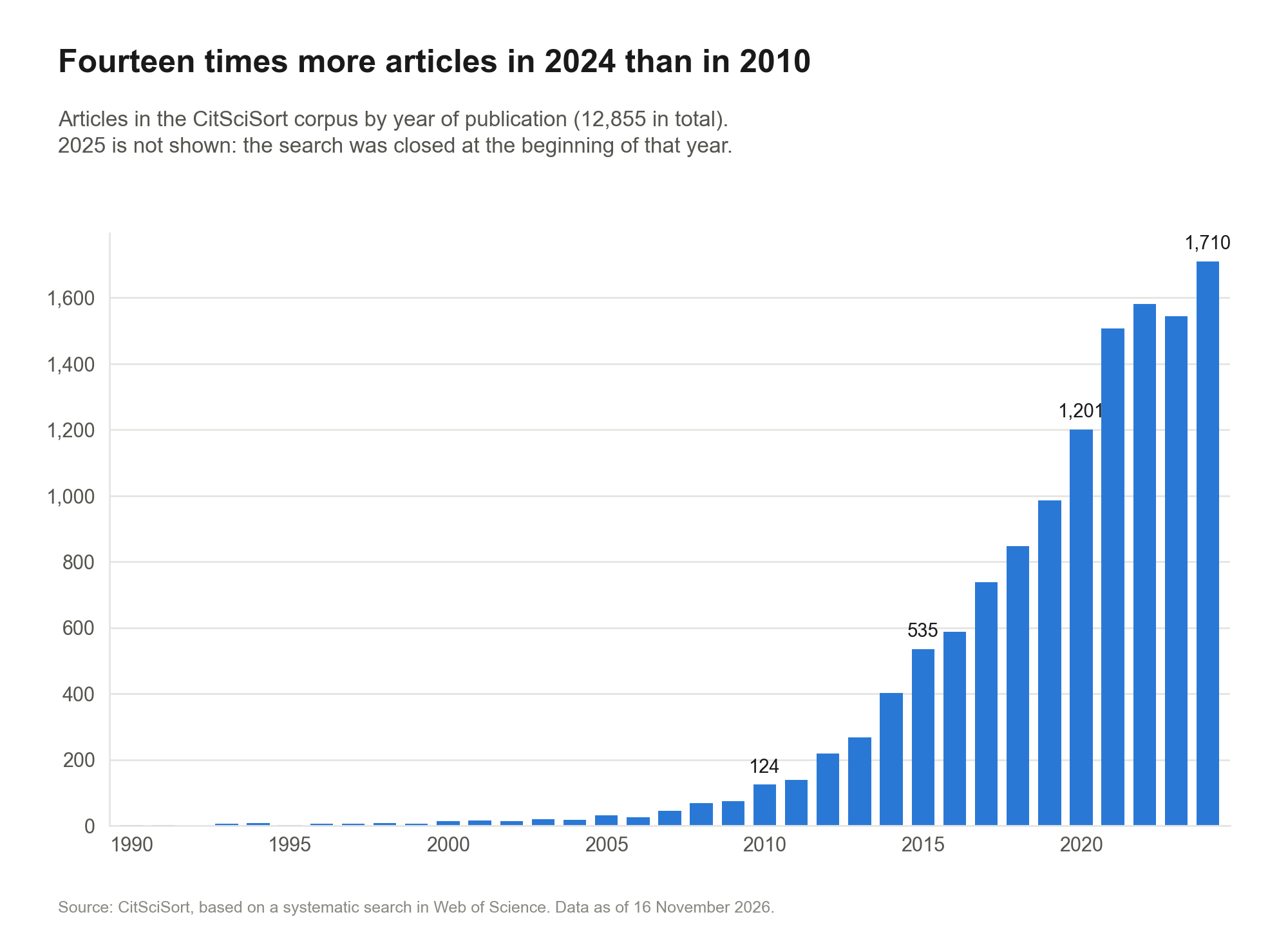
The corpus shows how fast citizen science research has grown. In 2010, 124 articles were published and in 2024 there were 1,710, almost fourteen times more. More than half of the whole set (59%) was published between 2020 and 2024. The 2025 figures are still partial, because the search was closed at the beginning of that year.
By discipline, the list is led by ecology (2,198 articles), environmental sciences (2,153) and biodiversity conservation (1,441). These are followed by electrical and electronic engineering (1,060) and two computer science categories, with about 900 articles each. Citizen science is also a matter of sensors, networks and algorithms. The category of education and educational research totals 328 articles, to which another 136 on teaching scientific disciplines are added.
Spain, seventh country in the world
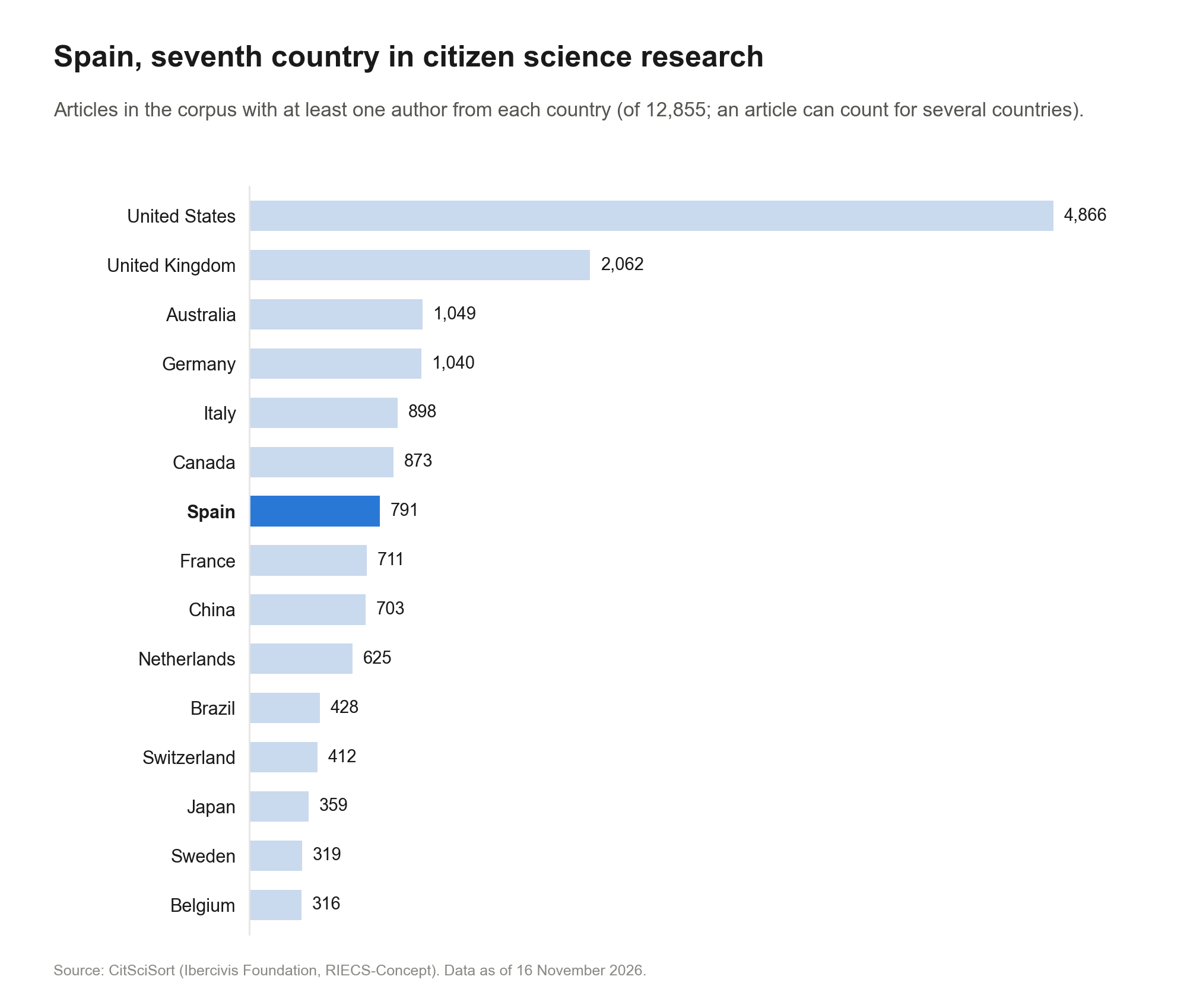
Authors’ affiliations show where research is being carried out. The United States appears in 4,866 articles and the United Kingdom in 2,062. They are followed by Australia, Germany, Italy and Canada, and in seventh place, Spain. There are authors from Spanish institutions in 791 articles, 6.2% of the corpus, ahead of France, China or the Netherlands. Spanish output has gone from 6 articles in 2010 to 140 in 2024.
The institutions that appear most often are the CSIC (62 articles), the Universitat Autònoma de Barcelona (about 34), the Universitat de Barcelona (30), the Universidad Complutense de Madrid (23) and the Universidad de Granada (20). They are followed by the universities of Seville, Valencia and Zaragoza.
What the first 1,700 readings say
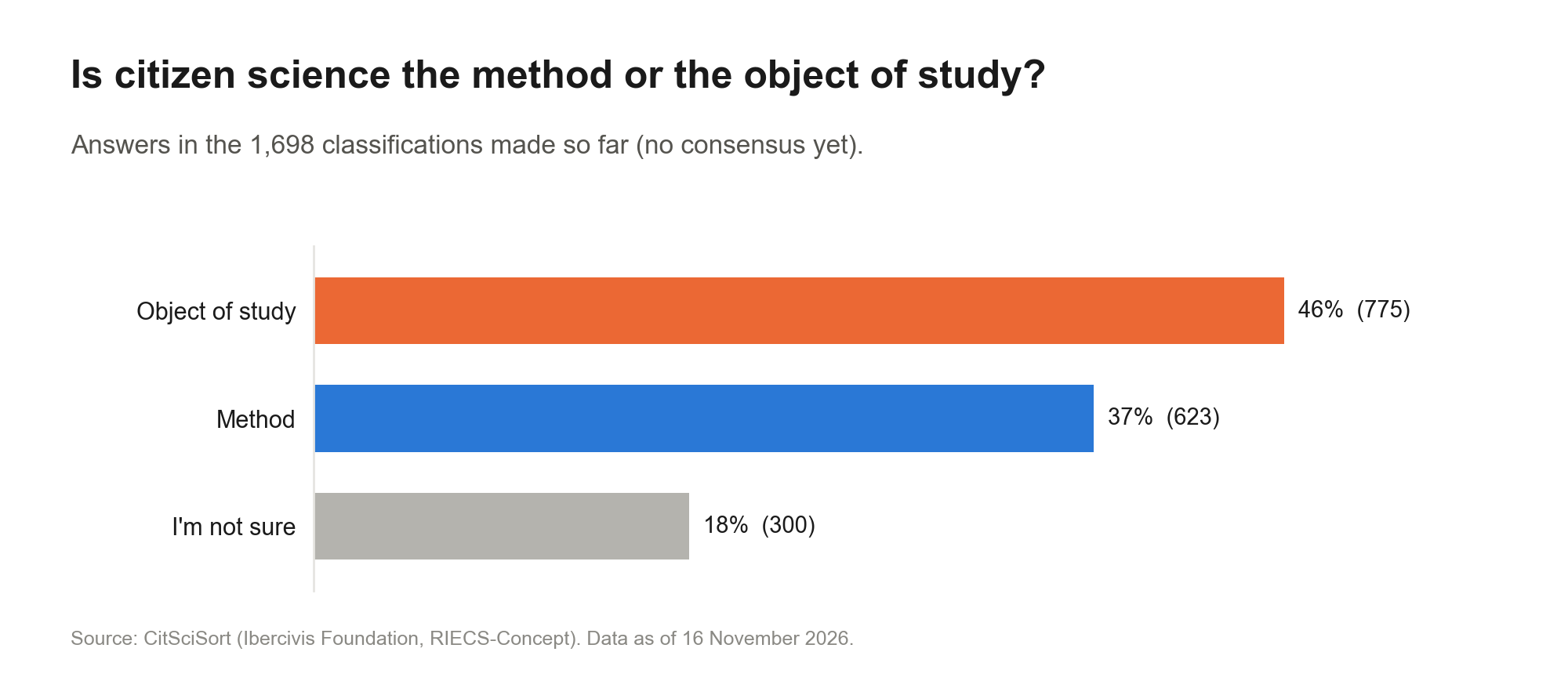
Of the 1,698 classifications made, 46% consider citizen science to be the object of study of the article, 37% that it is the method, and 18% cannot decide. That doubt is a result in itself, because the boundary between the two categories is not always clear.
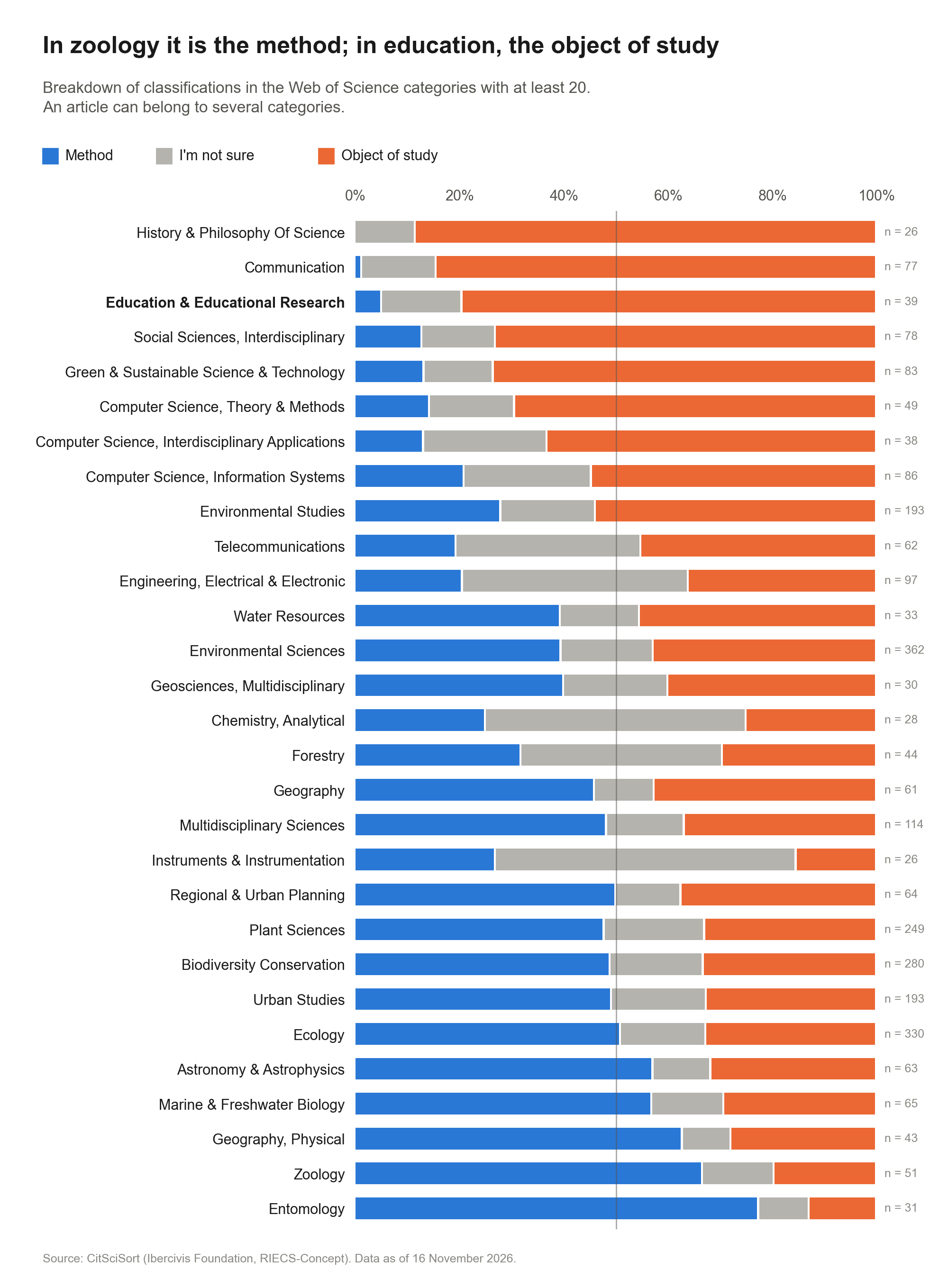
The most striking finding appears when classifications are split by discipline. In the natural sciences, citizen science is above all a tool for observing the world. In entomology, 24 of the 31 classifications consider it a method, and the same happens in zoology (34 of 51), marine biology (37 of 65) and astronomy (36 of 63). At the other extreme, in communication, computer science, sustainability and education, citizen science is what is being studied. In education, 31 of the 39 classifications (79%) consider it an object of study and only 2 consider it a method.
Doubt is not evenly distributed either. “I’m not sure” accumulates most in the technical disciplines: half or more of the classifications in instrumentation (15 of 26) and analytical chemistry (14 of 28), and 43% in electrical and electronic engineering. In those articles, which usually present a sensor or a device designed for citizens to use, it is hard to decide whether the result is a measurement of the world or an improvement to citizen science itself. These are precisely the cases where discussion between people adds the most.
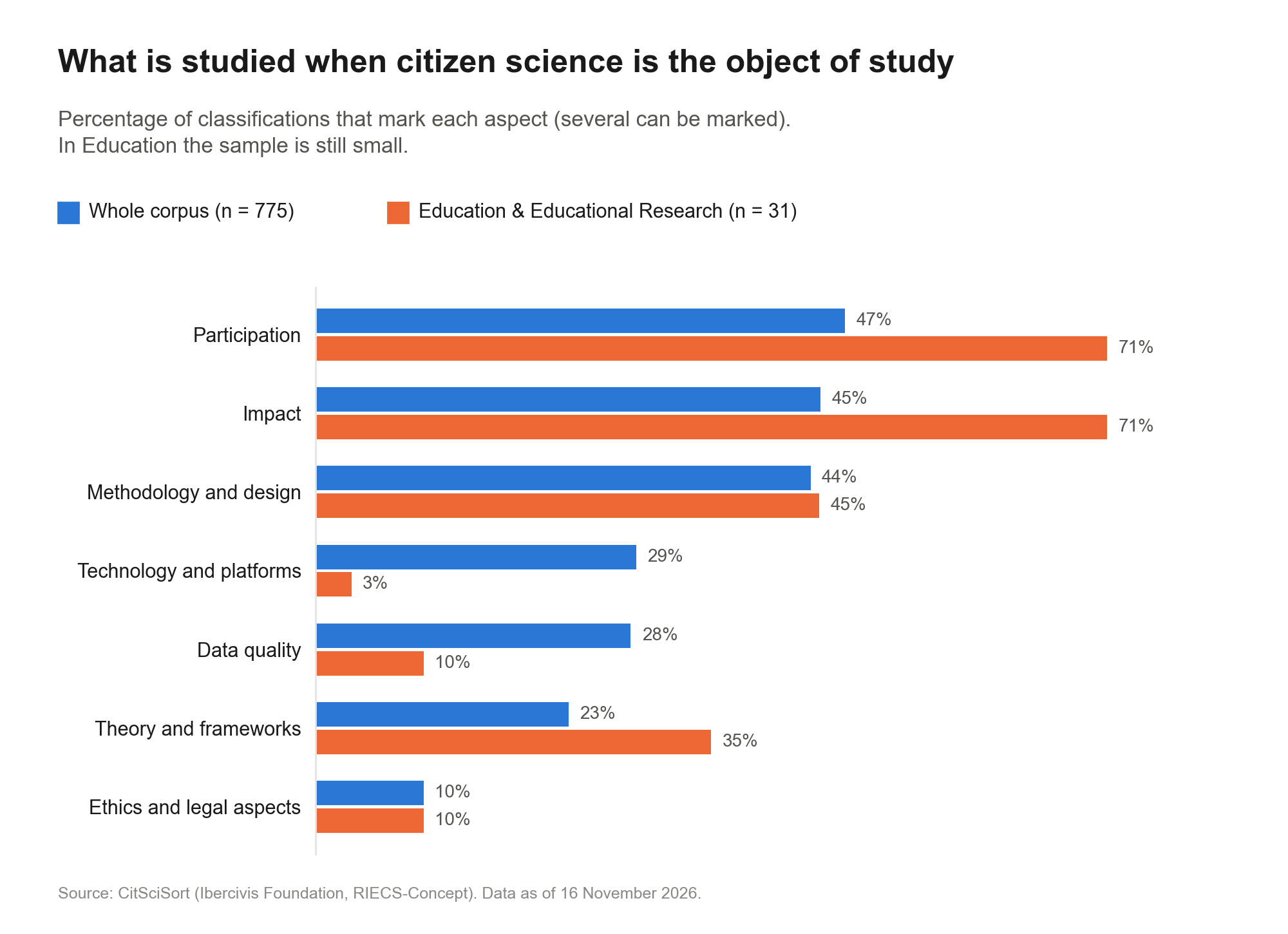
When citizen science is the object of study, the aspects most often marked are participation (in 47% of cases), impact (45%) and methodology (44%). Ethics appears much less (10%). Seven out of ten articles in this group deal with more than one aspect at a time. In education, impact and participation stand out, marked in 71% of cases, while technology appears in only one classification and data quality in three. Educational research mainly asks what citizen science produces in those who take part and how they get involved, and much less about the tools or the reliability of the data.
A field that matures
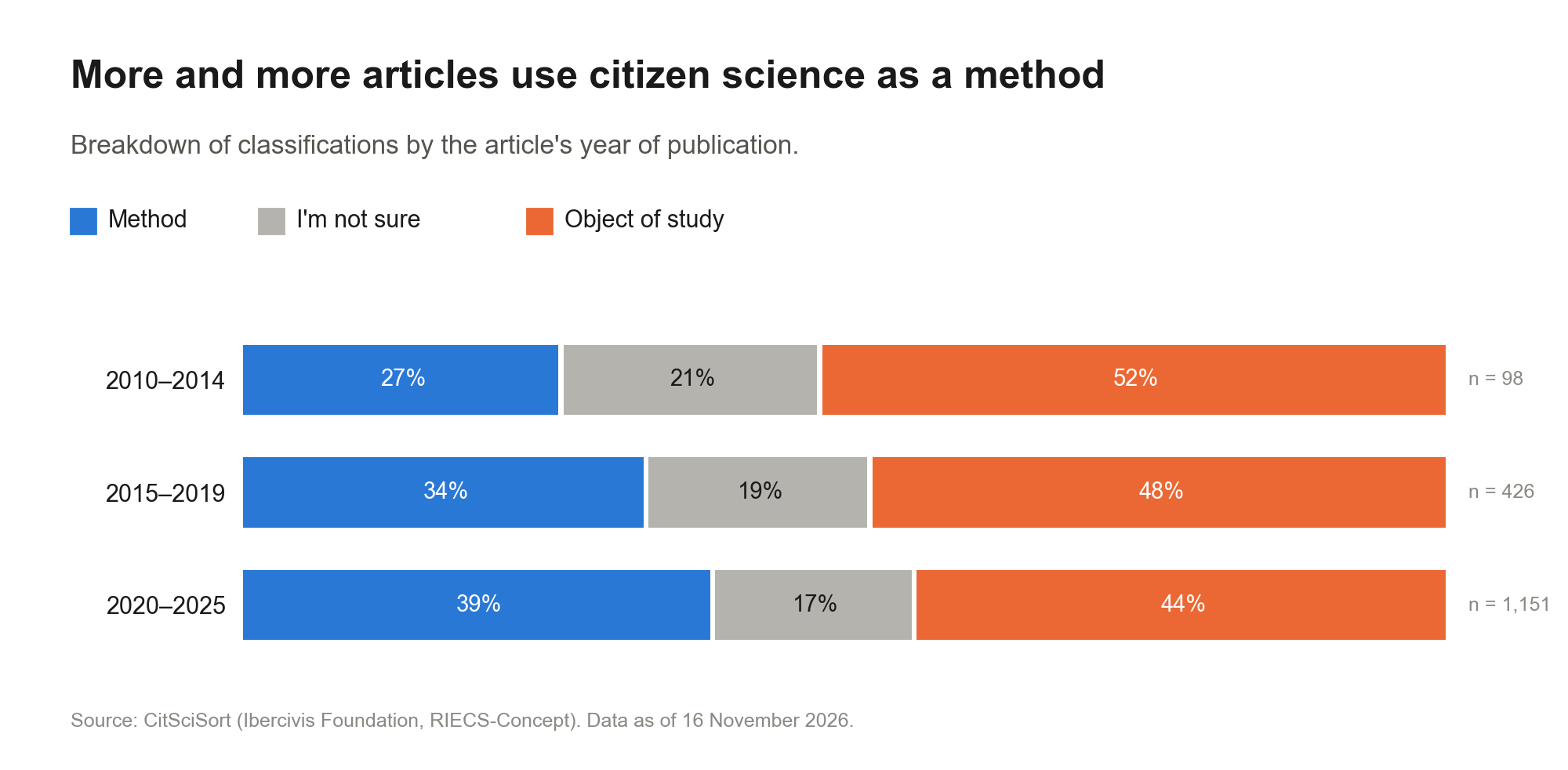
The classifications also show how research has changed over time. Among the articles published between 2010 and 2014, half (52%) studied citizen science and only 27% used it as a method. Among those published since 2020, the method has risen to 39% and the object of study has fallen to 44%. In the 2023 articles, for the first time, those that use citizen science as a tool (46%) outnumber those that study it (38%). Doubt also decreases, from 21% to 17%, as if the boundary between the two types were becoming clearer.
The most likely reading is that the field has matured. First, it was necessary to discuss how citizen science is done and whether its data is reliable. Once that was largely settled, more and more teams simply use it to answer their own questions.
The questions asked by those who study citizen science have also changed. In the articles from 2010 to 2014, the most marked aspect was technology (43%). Does the app work? Is the sensor useful? Since 2020, technology has fallen to 25% and participation (51%) and impact (49%) lead. Theory has risen from 16% to 25%, and ethics, which was almost absent in the first period (2%), reaches 13%. The question is no longer just whether citizen science works, but what it produces, how to understand it and whether it is fair to those who take part. That is precisely the terrain in which educational research operates.
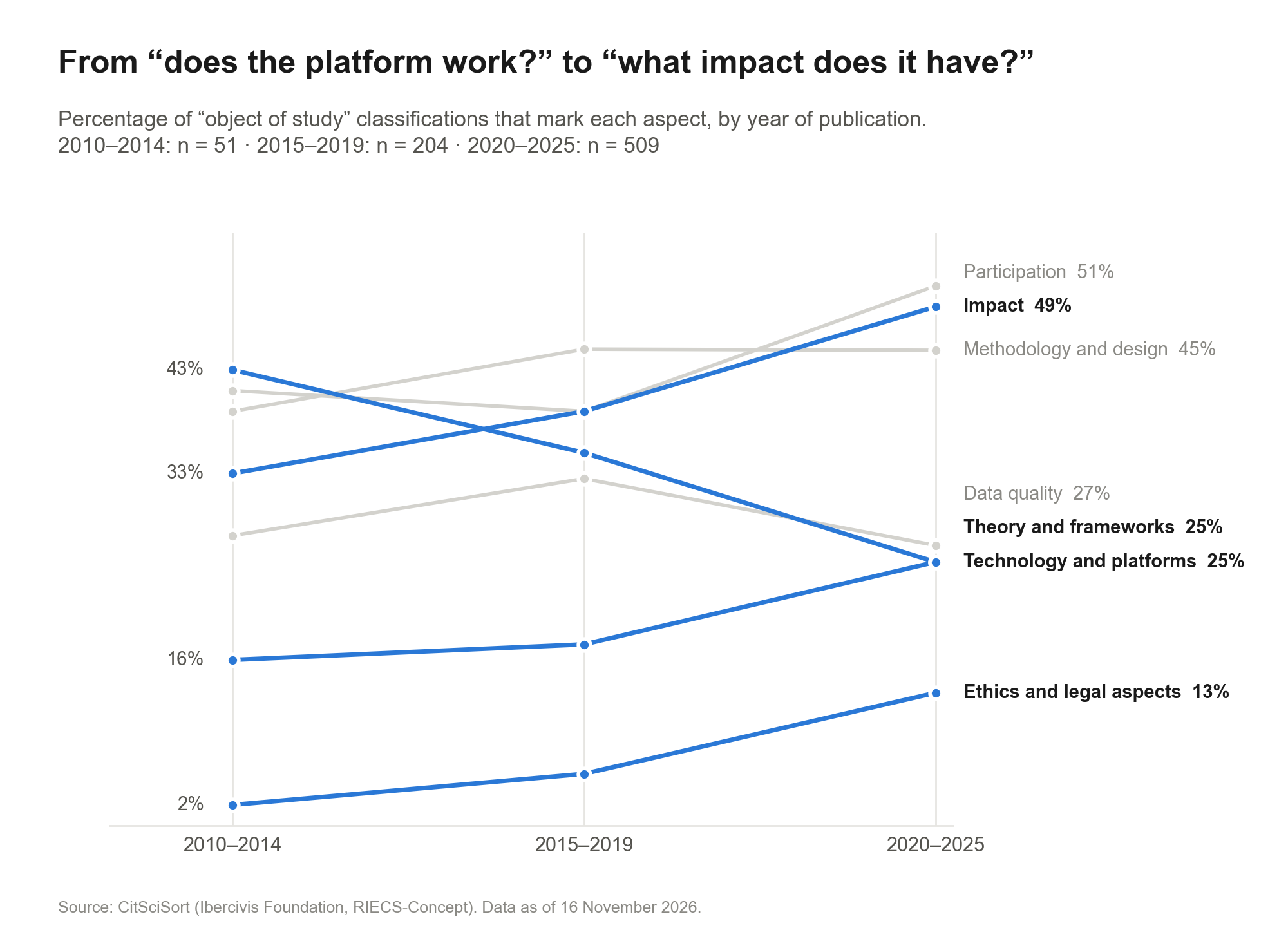
These trends are based on few classifications for the early years (98 between 2010 and 2014), so they should be read as an indication that will need to be confirmed.
Citizen science platforms
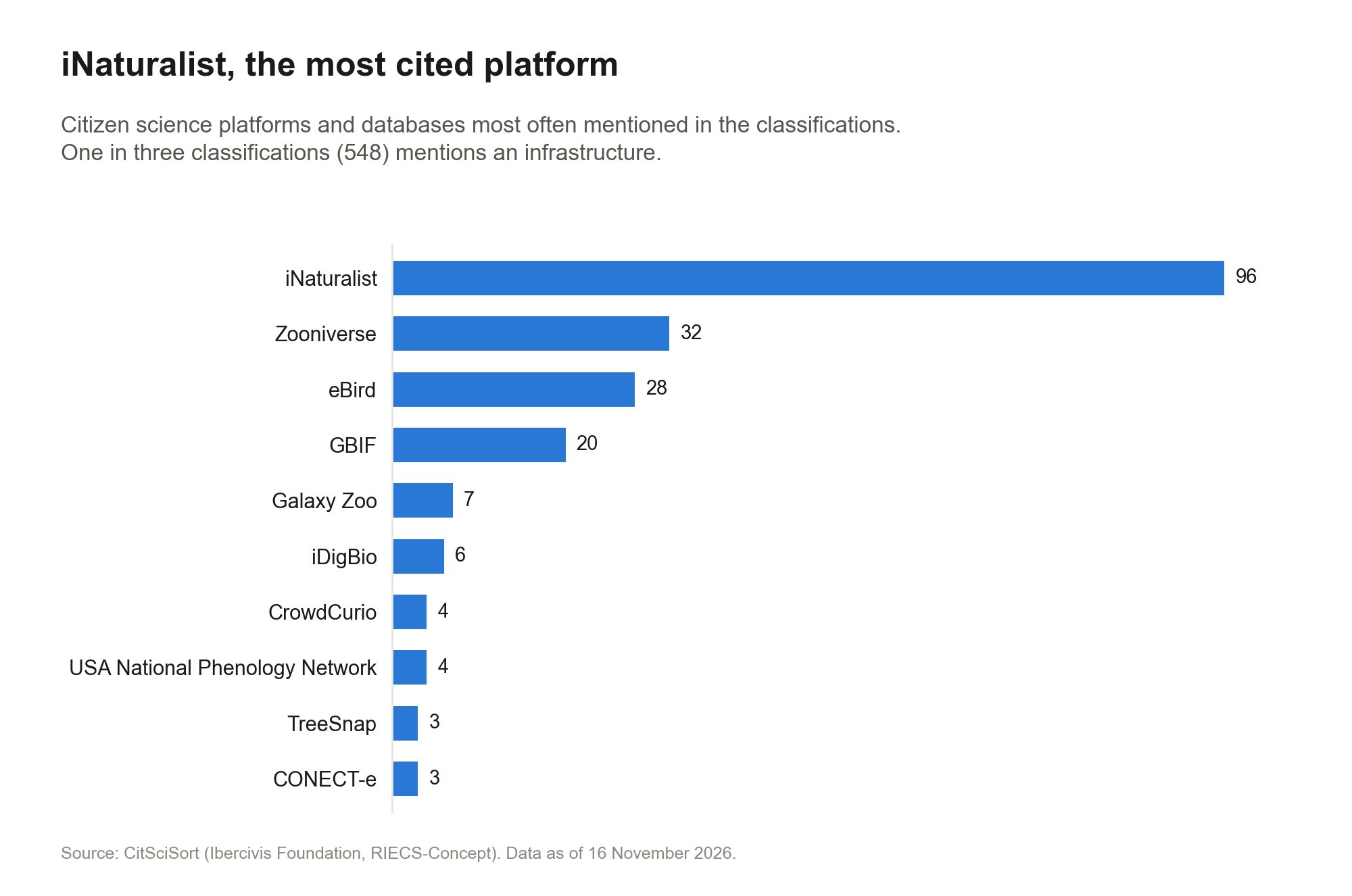
One in three classifications mentions a platform or tool. The most cited, by a wide margin, is iNaturalist (96 mentions), followed by Zooniverse (32), eBird (28) and GBIF (20). They do not all appear in the same way. iNaturalist and eBird are used mainly as tools: iNaturalist appears in 63 “method” classifications and 30 “object of study” ones, and eBird in 19 and 7. Zooniverse, by contrast, is both used for research and researched itself (14 and 17).
Why these results are provisional
Everything above is a first reading and should be taken with caution, for three reasons.
- Each abstract has, for now, a single reading. The design of CitSciSort requires five different people to classify each abstract before consensus is considered to exist, and none has yet reached that point. There is an encouraging sign: of the 44 abstracts that already have two readings, in 38 the two people agree, and in no case does one say “method” and the other “object of study”.
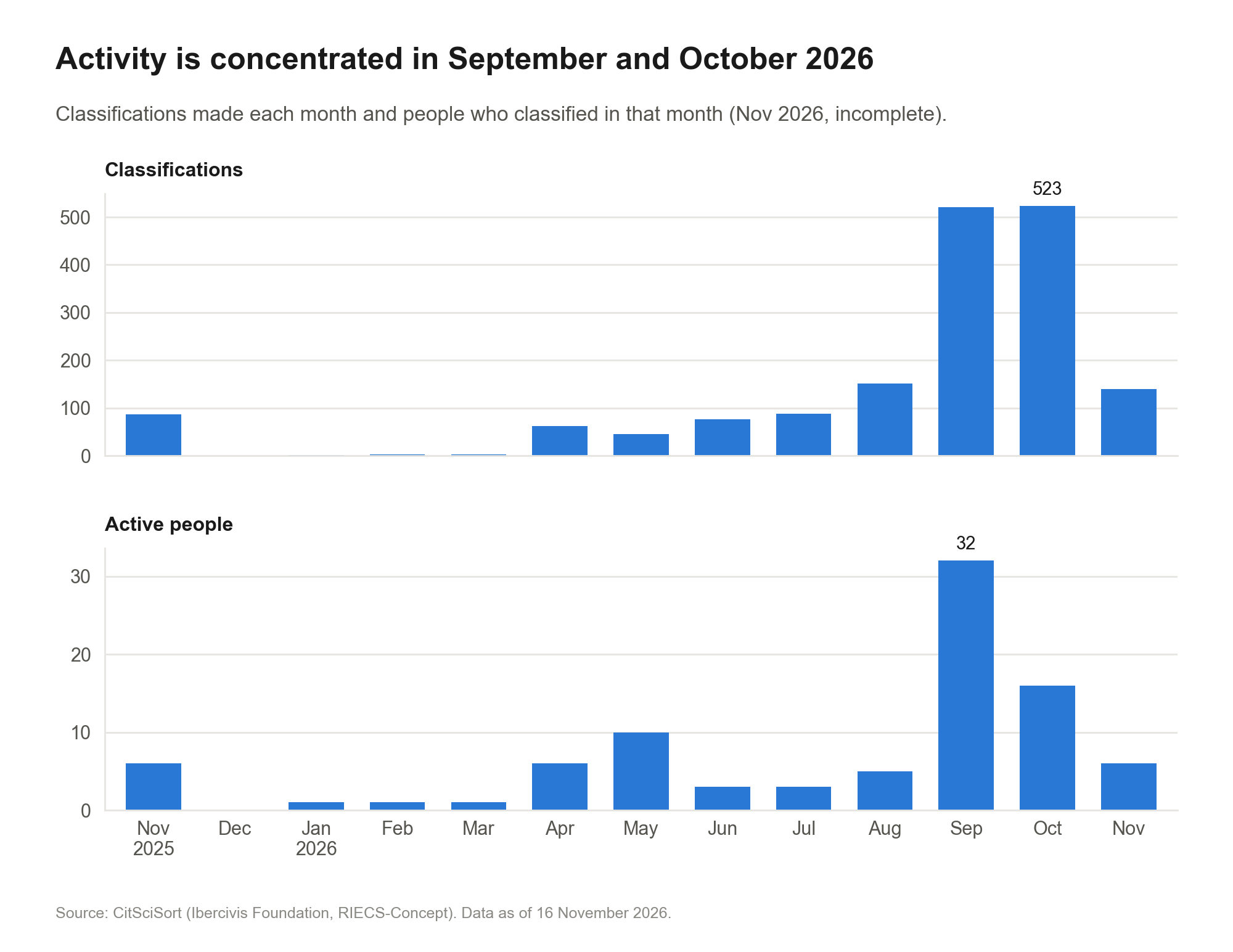
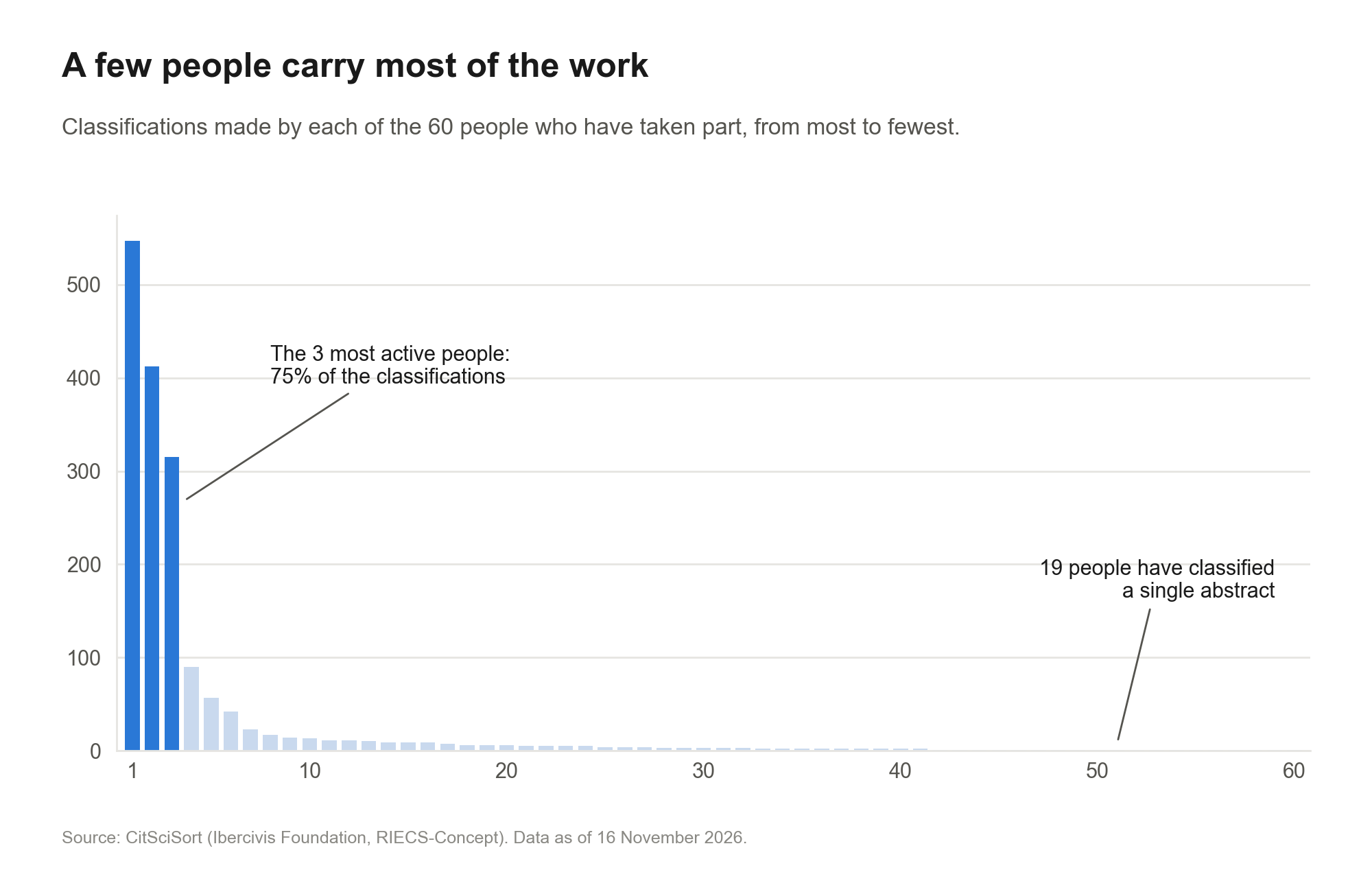
- Activity is highly concentrated. 61% of the classifications were made in September and October 2026, and three people contribute 75% of the total, while 19 have classified a single abstract. A pattern may reflect the judgement of those who classify most rather than that of the group as a whole.
- The sample is not random. Each person chooses which challenges to classify, by journal, keyword or discipline. The sample resembles the corpus fairly closely, but some areas, such as Environmental Studies, are overrepresented.
That is why more people are needed, to read more abstracts and also to read those that others have already classified.
Why people and not an artificial intelligence do this
A language model could label all 12,855 abstracts in a few hours. CitSciSort has deliberately opted for people, for several reasons.
- The question requires interpretation. Deciding whether citizen science is the method or the object of study does not depend on keywords, but on understanding what the article claims. Many abstracts combine both, and the 18% of “I’m not sure” shows that the boundary is not always clear. A person can recognise that doubt, comment on it and open a debate with others. A model tends to always give an answer, with the same confidence whether it is right or not.
- The scheme is still being built. Those who classify are not limited to choosing among closed options. In addition to the seven aspects, they can use additional labels and propose new ones, as they have already done with well-being or connection with nature, and they have opened debates on specific cases. This critical review of the categories is part of the research result.
- Without a human reference, no machine can be evaluated. To know whether an automatic tool classifies well, you need a dataset classified by people to compare it against. CitSciSort is building precisely that reference, with the goal of gathering five independent readings per abstract. If artificial intelligence is used in the future to extend the analysis, it will be possible to check how accurate it is.
- Models inherit the biases of what they have read. A model trained on the existing literature tends to reproduce the dominant ways of understanding citizen science. The aim here is precisely to look at that body of work from a distance.
- Learning is part of the goal. If a machine did the classifying, nobody would take away the view of the field that participants gain today.
Open data and a scientific paper with open authorship
CitSciSort works in the open. The classification scheme, with its definitions and references, is public on the platform itself. The abstracts come from publications accessible at their original sources, which remain the reference for each record.
When this analysis is finished, two things will be published. First, the dataset with the classifications, openly, so that any person or team can reuse it, check the results or carry out their own analyses. Second, a scientific paper with the research results. Authorship of that paper is open to new people: those who take part and want to collaborate on the analysis and writing can indicate this in their CitSciSort profile, with the option to collaborate on the paper (Paper collaboration). Those who prefer more discreet recognition can ask for their name to appear in the acknowledgements, and those who wish can take part anonymously.
Online workshop: classify citizen science research in education
Of the 328 articles in the education and educational research category, only 39 have a first reading. To start filling that gap, the Ibercivis Foundation is organising an online workshop, within the RIECS-Concept project.
- When: Wednesday 2 December 2026, from 16:00 to 17:00 (mainland Spain time; 15:00 to 16:00 in the Canary Islands, Portugal and the United Kingdom).
- Where: on Zoom.
- What we will do: a short introduction to the classification scheme and then classify education article abstracts together and discuss the doubtful cases.
- Who it is for: teachers, education researchers, people who coordinate citizen science projects and anyone who is curious. No prior experience is needed.
- Before the workshop: create your CitSciSort account. You can sign in with a Google account.
If each participant classifies between fifteen and twenty abstracts in an hour, about twenty people can give a first reading to almost all the education articles in the corpus. The result will be incorporated into RIECS-Concept, the open data and the scientific paper, and will help us better understand what the education community researches when it talks about citizen science. Those of you who take part will also take away an overview of educational research in citizen science that is hard to obtain in any other way in one afternoon.
If you cannot attend, you can classify whenever you like at citscisort.ibercivis.es, in your own area or in one that sparks your curiosity. If you want to join the authorship of the scientific paper, activate it in your profile.
Authors: Francisco Sanz-García, Maite Pelacho, Fermín Serrano-Sanz, Alejandro Sánchez Rubio, Anna Markova, Alberto Jiménez-Gómez, Judith Bielsa, Lucía Moreno, Daniel Lisbona
Data extracted from the CitSciSort database on 16 November 2026. The classifications are provisional and have not reached consensus.
RIECS-Concept has received funding from the European Union’s Horizon Europe research and innovation programme.