

In Spain, the active participation of non-professionals in research has multiple impacts, political ones among them, that reach beyond the specific fields (health, the environment, social challenges, etc.) in which projects are carried out. Citizen science in Spain has become part of the strategies, incentives and institutions of the science and innovation systems.
This integration does not mean that citizen science has been absorbed by institutions, whether academic or political. On the contrary, it is an institutionalisation in a broad sense that reflects a two-way interaction or, better, a co-evolution between citizen practices and public policy. On the one hand, initiatives generate evidence that can inform administrative decisions throughout the policy cycle (citizen science for policy). On the other hand, institutional recognition adapts or creates rules and resources that can support the continuity and autonomy of these practices (policy for citizen science).
Although the term is a contemporary one, citizen science has a history going back centuries, in Spain too. Some examples are the Relaciones Topográficas promoted by Philip II in 1575, Pascual Madoz’s Dictionary in the 19th century and the volunteer networks for meteorological, phenological and ornithological observation of the 20th century, as well as countless actions that still need to be identified. The historical background of citizen research in Spain has thus been a key factor in its evolution and current development.
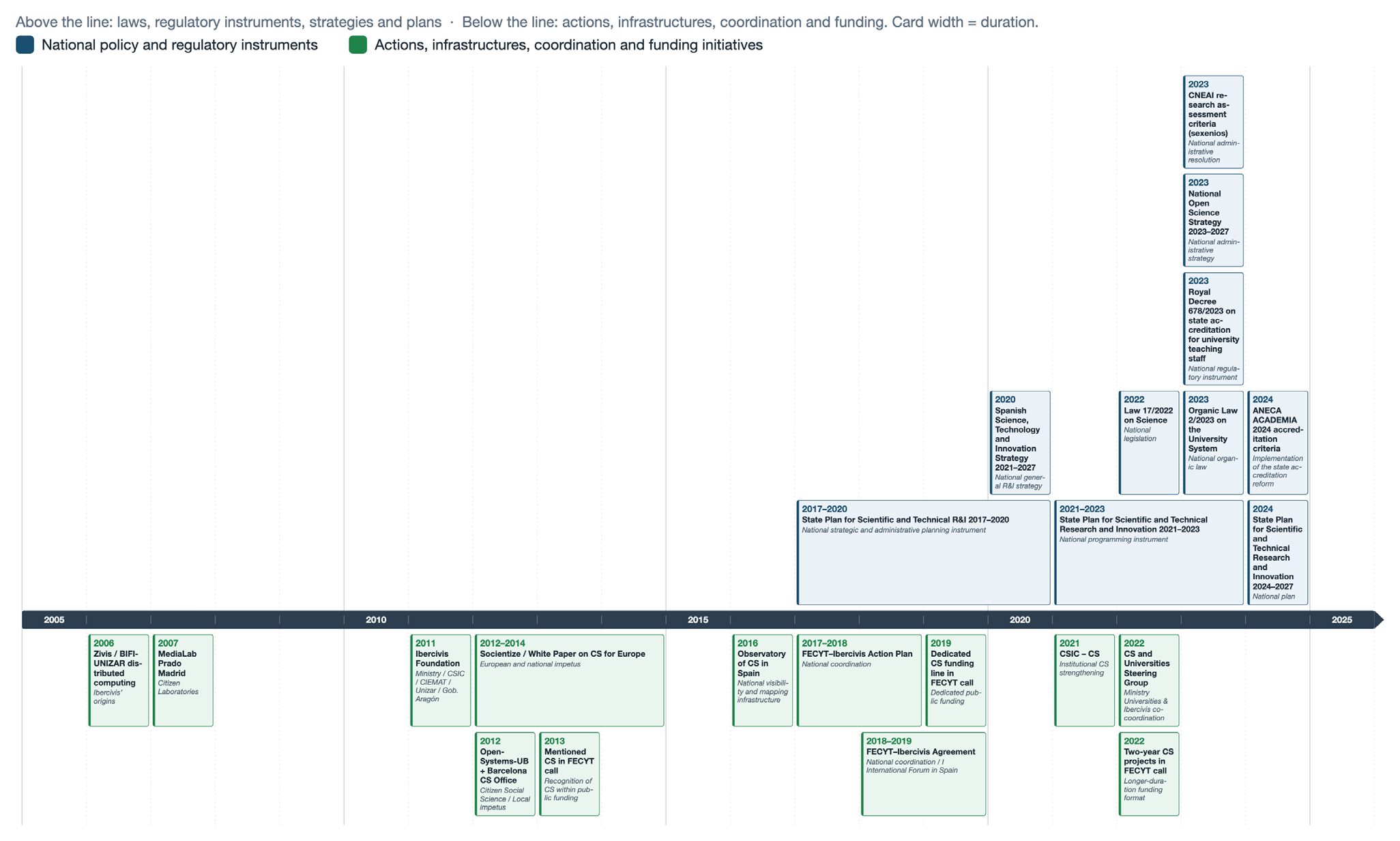
The move towards national coordination began in the early 21st century, with milestones that include the success of the Zivis and Ibercivis projects, by the University of Zaragoza and CIEMAT from 2006 onwards, which led to the creation of the Ibercivis Foundation (2011) under the impetus of its board of trustees, made up of CSIC, CIEMAT, the Government of Aragon, the University of Zaragoza and the Ministry of Science, Innovation and Universities (under its various names); the work of Medialab-Prado Madrid (2007) together with hundreds of actors from many sectors; the research of the OpenSystems group at the University of Barcelona (2012); and the institutional support of CSIC, both through its early backing of Ibercivis –and of the whole citizen science community in Spain– and through its own research.
Since isolated projects rarely reach the spaces where policies are designed, these organisations and others, working in coordination, acted as systemic intermediaries: they connected scattered initiatives, promoted shared infrastructures and began to build a networked national citizen science community. The Observatory of Citizen Science in Spain (ciencia-ciudadana.es), launched in 2016 by Ibercivis in collaboration with FECYT, made initiatives in Spain more visible and helped to build the community. Drawing on that experience, Ibercivis developed the European platform (citizenscience.eu), which is being adapted by other organisations and countries. FECYT and Ibercivis coordinated several action plans between 2017 and 2019 together with hundreds of actors in Spain working in citizen science, with or without that name. At the same time, public funding was maturing. After being included in FECYT’s scientific culture calls in 2013, citizen science obtained a dedicated funding line in 2019 and two-year flagship projects in 2022, in recognition that generating rigorous knowledge and building trust and stable communities requires longer time frames.
Between 2020 and 2024 came codification in national regulation, with citizen science explicitly included in the Spanish Science, Technology and Innovation Strategy (2021–2027), the reform of the Science Act (Ley 17/2022), the Organic Law of the University System (LOSU, Ley Orgánica 2/2023) and the National Open Science Strategy. A significant shift took place in research assessment: in line with the European CoARA reform, the CNEAI criteria for six-year research periods (sexenios, 2023) and the ANECA teaching and knowledge-transfer accreditations (Royal Decree 678/2023 and the 2024–2025 frameworks) now recognise citizen science as a research merit with social value. This is highly relevant for recognising academic work in full and, at the same time, for understanding that this merit is tied to collaboration with citizens. Knowledge transfer is not always one-way: it also involves exchange.
The case of Spain shows how citizen science can influence the very organisation of research, helping to change its rules, resources, relationships and evaluation systems. Consolidating this progress now requires giving greater stability to coordination networks and securing permanent infrastructures, something that the RIECS-Concept project (led by Ibercivis, with CSIC among its twelve partners) is addressing through the design of a European research infrastructure based on shared resources, quality standards, ethical protocols and technical interoperability, so that citizen science can develop with excellence, in all its dimensions, and as a stable component of the European Research Area.
Pelacho, M., Sanz-García, F., Serrano-Sanz, F., Paneque-Salgado, P., Bautista-Puig, N. and Leza, M. 2026. Evaluating the System-Level Policy Impact of Citizen Science in Spain: The Co-Evolution of Citizen Science Practices and Research and Innovation Policy. Citizen Science: Theory and Practice, 11(1): 48, pp. 1–15. DOI: https://doi.org/10.5334/cstp.1017