

Every point on our interactive map tells a story of environmental commitment. Through Life-Nitrazens, a project in which Ibercivis participates, citizens across Spain and Portugal are becoming the eyes and hands of science, using the Geonity App technology to monitor the health of our river basins and build transparent, participatory water governance.
The pulse of the map: thousands of samples to protect our water
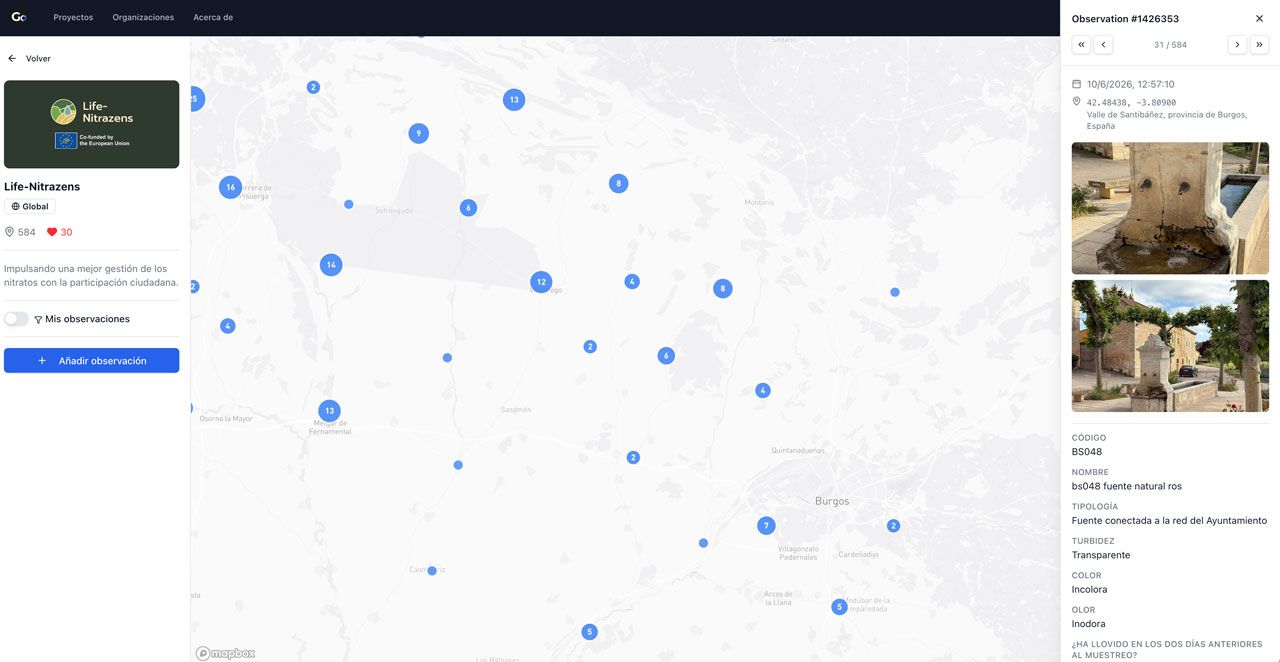
The digital heart of Life-Nitrazens is a living map of open data during this sample collection phase. Our commitment is ambitious: to mobilise at least 2,500 citizens to collect and analyse 3,000 water samples (surface, groundwater and tap water). This large participatory monitoring network covers a representative area of 34,435 km², connecting the Duero and Ebro river basins in Spain (30,412 km²) with the Mondego basin in Portugal (4,013 km²).

Thanks to this collective effort, the project is managing to fill critical environmental information gaps in small bodies of water and rural areas that are often left out of official monitoring networks, democratising information and ensuring that the data is accessible to everyone. This effort has already resulted in almost 600 samples collected across dozens of measurement points throughout the Ebro and Duero basins in this first sampling phase, which has also laid the groundwork for the citizen infrastructure of nodes, ambassadors and participants who will continue collecting samples in the following stages of the campaign.
In addition, the data provided by citizens during these nitrate monitoring campaigns will be available on the Life-Nitrazens Data Exchange Platform currently being developed by the project, as well as on the federated data space also under construction, making it available not only for consultation but also for use in scientific research on nitrate pollution in our bodies of water.
Geonity: Ibercivis’s technology bringing rigour to citizen science
How do we ensure that a sample taken by a neighbour in their village is scientifically valid? This is where Geonity comes in, the citizen science platform developed by Ibercivis, a partner in the project. This mobile app, already used in other projects run by the foundation, has been specifically adapted for Life-Nitrazens to guide volunteers step by step in a simple and intuitive way.
When arriving at a water point, participants use Geonity to:
- Geolocate the sample with precise GPS coordinates. To protect privacy on the public map, the system blurs points of a private nature (such as domestic wells or taps), showing only an approximate area.
- Record key metadata such as the type of water (tap, well, canal or river), the date, the exact time of collection, and the weather conditions at that moment.
- Upload photographs of the surroundings that provide visual context to facilitate scientific analysis and validation of the sample.
Even if a participant is in a natural area without mobile coverage, the app saves all the data locally and sends it automatically to the server as soon as an internet connection is restored. This digital record is essential; the quality control protocol requires that every bottle handed in be linked to its metadata on the platform so that laboratories can process it and guarantee the sample’s traceability.
The design of our campaigns: a cyclical and rigorous roadmap
To ensure that the data reflects seasonal and temporal changes in water, the project is structured into three major sampling campaigns of five months each:
- Campaign 1: April to August 2026, recently concluded and yielding excellent participation figures.
- Campaign 2: October 2026 to February 2027.
- Campaign 3: April to August 2027.
Each of these campaigns operates under a rigorous operational cycle divided into five phases, repeated in order:
- Phase I – Network setup: Physical collection Nodes are activated, and local Ambassadors who mobilise the volunteer community are trained.
- Phase II – Mini-campaign preparation: Short, time-bound windows to optimise logistics, define sampling points, and hand out scientific kits (bottles, labels and cool bags) to volunteers.
- Phase III – Field sampling: The big day of fieldwork. Volunteers perform a triple rinse of the bottle beforehand with water from the point itself to remove impurities, fill the container avoiding air bubbles, and store it in the insulated bag protected from heat. Timing is critical: the sample must be delivered to its reference Node within a maximum of 3 hours to prevent the nitrates from being chemically altered.
- Phase IV – Logistics and laboratory analysis: Samples are immediately refrigerated at the Nodes and transported weekly under strict cold-chain conditions to the reference laboratories: the University of Burgos (UBU) for the Duero basin, CITA-Aragón for the Ebro basin, and the University of Coimbra together with Águas do Centro Litoral for the Mondego basin. There, the exact nitrate concentration (in mg/L) is analysed with technical precision.
- Phase V – Data validation and transparency: Before publication, analytical results are cross-checked and validated against the metadata recorded by participants in the app and the Nodes’ control sheets. Once validated and quality-assured, they are integrated into the Life-Nitrazens Data Exchange Platform (developed by Osoigo) for free public viewing and download under the Open Science model.
A heartfelt thank you to our community
None of this would be possible without the extraordinary social fabric that sustains the project. As a partner in Life-Nitrazens, Ibercivis would like to express its gratitude to each and every Ambassador for being the social driving force in their rural communities. To the local Nodes (town councils, civic centres and associations) for lending their spaces and safeguarding the samples so generously. And, of course, to every participant who has decided to dedicate their time to collecting water so that their effort becomes scientific knowledge.
Thanks to all of you, we are building a collective tool that protects public health, safeguards our ecosystems, and guides administrations towards fairer and more effective water policies.

Join the change: take part in the upcoming campaigns
Want to know what kind of water flows through your nearest tap, well or river? Want your commitment to turn into useful data to protect your area? The LIFE-NITRAZENS Local Support Network is still going strong and is always open to new hands.
It doesn’t matter if you didn’t take part in the previous phases; each new mini-campaign is a fresh opportunity to start from scratch. Sign up through our official form and we’ll assign you your nearest Node, welcoming you into our active WhatsApp community so you can receive your scientific kit and all the training you need.
Sign up here to take part as a volunteer or ambassador!